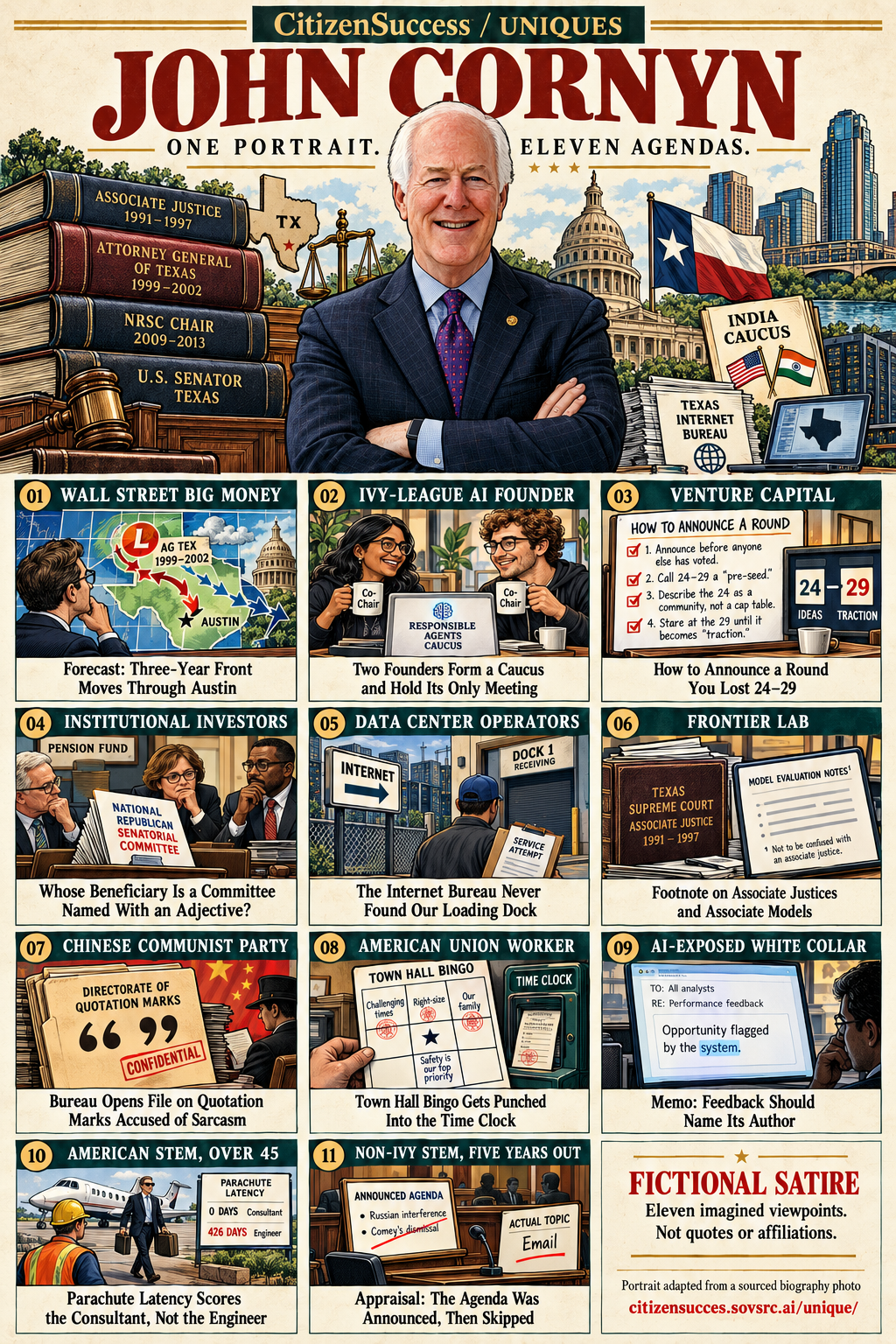
Eleven fictional viewpoints
These descriptions are fictional satire, not quotations or evidence of political beliefs or affiliations.
01 Wall Street Big Money Financier
Forecast: Three-Year Front Moves Through Austin
The markets sketch it as a weather map. A low-pressure system labeled Attorney General of Texas from 1999 to 2002 drifts over tax treatment, drags a front across municipal bonds, then dissolves into the Senate. Liquidity is told to expect scattered subpoenas of the imagination. Systemic risk is advised to carry a coat. Forecasters add that the front, unlike every desk's outlook, kept its dates.
02 Silicon Valley / San Francisco Ivy League AI Founder
Two Founders Form a Caucus and Hold Its Only Meeting
Over oat-milk flat whites in the Mission, Priya and her fiercest rival decide to copy whoever co-founded the U.S. Senate India Caucus. 'We'll call it the Responsible Agents Caucus,' she says. 'Then we never undercut each other.' He agrees, provided he is co-chair. So is she. They have two chairs, no members, and one standing agenda item: whose logo goes left of the other's.
03 Venture Capital
How to Announce a Round You Lost 24–29
Step one: announce your round before anyone else has voted. Step two: if you lost to John Thune on the second ballot, 24–29, insist the first ballot was a pre-seed. Step three: describe the 24 as a community, not a cap table. Step four: stare at the 29 until it becomes 'traction' and the 24 becomes 'learnings.'
04 Institutional Investors
Whose Beneficiary Is a Committee Named With an Adjective?
If a man chaired the National Republican Senatorial Committee from 2009 to 2013, was that a four-year lock-up or merely a long meeting? The pension board wonders whether a chair owes fiduciary duty to the members, to the letterhead, or to the next vintage of senators. And who audits a benchmark that consists entirely of the word 'Senatorial'?
05 Data Center Operators
The Internet Bureau Never Found Our Loading Dock
Records say Cornyn created the Texas Internet Bureau to investigate illegal internet practices. We admire the jurisdictional courage. But the internet has a street address, and it is ours: forty megawatts, one chiller loop, a water permit pending. Had the bureau tried to serve it, the process server would have been sent to our dock, then to a hearing about fan noise, where the internet would wait in line like everyone else.
06 Frontier Lab
Footnote on Associate Justices and Associate Models
Our system card thanks the reviewers for their oversight.¹ ¹ Not to be confused with an associate justice of the Texas Supreme Court from 1991 to 1997, an office we picture as one where reasoning ends up on paper. Our own evaluation notes, by comparison, are available on request, redacted on receipt, and described in the abstract as 'rigorous.'
07 Chinese Communist Party
Bureau Opens File on Quotation Marks Accused of Sarcasm
The bureau's rule is that whoever repeats a sentence owns it, so the file on a 2019 tweet that mocked centralized power by quoting Italian fascist leader Benito Mussolini arrives stamped 'confession.' Then comes the reversal: the quotation marks, not the speaker, are found to be carrying the mockery. The bureau founds a Directorate of Quotation Marks, whose first ruling is that every mark must be supervised by a second mark.
08 American Union Worker
Town Hall Bingo Gets Punched Into the Time Clock
The crew heard that Cornyn's staff passed out bingo cards to reporters, who stamped a square at each stock phrase. The steward took 'stamp' literally and brought the cards to the time clock. Now 'challenging times,' 'right-size' and 'our family' each count as ten paid minutes of listening. The center square, 'safety is our top priority,' arrives pre-stamped, which is how everyone learns who printed the cards.
09 White Collar Professional in an AI-Threatened Group
Memo: Feedback Should Name Its Author
TO: All analysts. RE: Performance feedback. Last cycle's note arrived as 'Opportunity flagged by the system.' Compare: The Republican Party of Texas rebuked him for this, a sentence with a named author, a named target, and a stated reason. Effective Monday, our reviews will adopt none of those features. Questions go to the tool that drafted this memo, which has not been rebuked by anyone.
10 American STEM Worker Over 45
Parachute Latency Scores the Consultant, Not the Engineer
Our absurd metric is Parachute Latency: days between arrival and credit. Cornyn told a colleague, "you just parachute in here on the last day." Our consultant lands on the final Friday, scores zero latency, and is named architect. The engineer who sat through fourteen months of negotiations scores 'present.' He has asked to be dropped in on the last day next time, with expenses.
11 American STEM Graduate Five Years Out of College (Not Ivy League)
Appraisal: The Agenda Was Announced, Then Skipped
Appraisal: a hearing's announced topic was Russian interference and Comey's dismissal, yet the senator opted instead to spend his time questioning James Comey about email. I respect the range. My interview listed 'embedded C debugging'; the panel spent forty minutes on whether I am 'a builder.' Feedback: candidate strayed from the agenda. The agenda had been shared with no one.
 CitizenSuccess