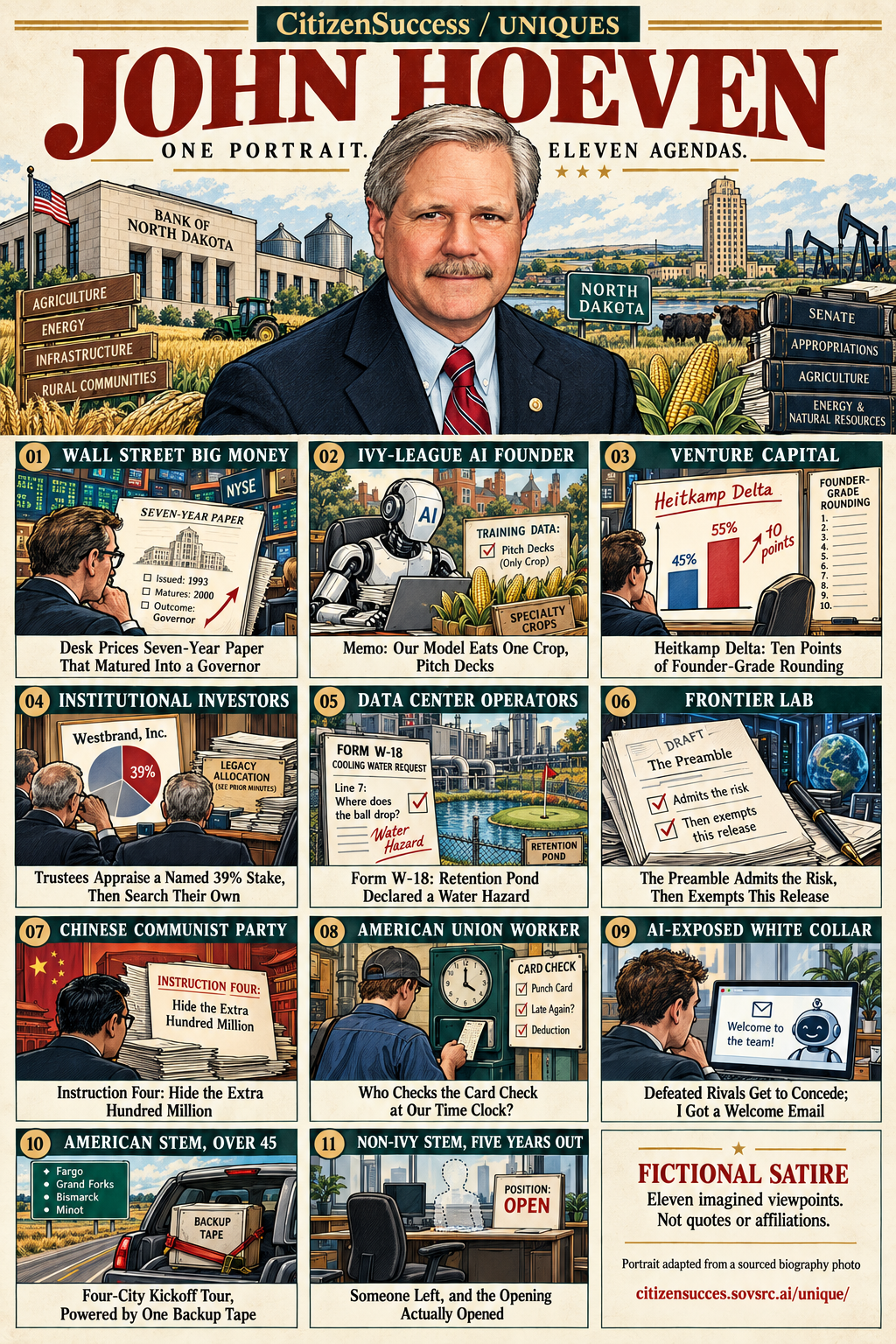
Eleven fictional viewpoints
These descriptions are fictional satire, not quotations or evidence of political beliefs or affiliations.
01 Wall Street Big Money Financier
Desk Prices Seven-Year Paper That Matured Into a Governor
Told he was CEO of the Bank of North Dakota from 1993 to 2000, the desk stamps it seven-year paper and requests the coupon. Informed it matured into a governor's race, traders ask for the prospectus. Nobody on the floor has ever held paper that matured into a bigger title. Theirs matured into a farewell lunch.
02 Silicon Valley / San Francisco Ivy League AI Founder
Memo: Our Model Eats One Crop, Pitch Decks
MEMO — Re: our training diet. Someone chairs a subcommittee on Nutrition, Specialty Crops, Food and Agricultural Research, and it occurs to me that we feed our model a single crop: our own pitch decks. Finding: monoculture. Action: diversify inputs, beginning with one heirloom dataset, which Legal asks us to call 'specialty' and price at triple.
03 Venture Capital
Heitkamp Delta: Ten Points of Founder-Grade Rounding
Partners coin the Heitkamp Delta after reading that he defeated Democratic NPL nominee Heidi Heitkamp, 55% to 45%. Ten points, they note, is roughly how far an average deck overstates its market. By this metric, every pitch wins its election and then loses its diligence call.
04 Institutional Investors
Trustees Appraise a Named 39% Stake, Then Search Their Own
Appraisal. At one time, he owned 39% of the parent company of his father's bank, Westbrand, Inc. The committee finds this stake named, sized and attributable to a person. By contrast, its own 39% sleeve is labeled 'legacy allocation, see prior minutes,' and no trustee recalls buying it. Recommendation: sell nothing, locate the minutes, and name the sleeve after somebody.
05 Data Center Operators
Form W-18: Retention Pond Declared a Water Hazard
FORM W-18, COOLING WATER REQUEST. Applicant background: While there, he played on the men's golf team. The operator pencils 'water hazard' beside the retention pond, hoping the permit office sympathizes with a sport that waters eighteen holes. The clerk accepts the label, assesses a one-stroke penalty, and asks why the pond has no flag. Line 7: Where does the ball drop?
06 Frontier Lab
The Preamble Admits the Risk, Then Exempts This Release
'Draft the preamble,' says Mina. Jonas types: frontier models carry real risks, we contribute to them, but this release will not. Mina frowns. 'That's the amendment shape: climate change is real and that humans are contributing to it, but one pipeline isn't.' 'Same hatch,' Jonas says. Legal asks whether the exemption can be a checkbox, pre-ticked.
07 Chinese Communist Party
Instruction Four: Hide the Extra Hundred Million
Comrades, file this. Instruction 1: record that in late 2006 the state's reserve rose past $600 million, and later past $700 million. Instruction 2: find the quota this overfulfilled. Report: none; money was merely kept. Instruction 3: ban publicity, lest neighboring provinces conclude that saving is permitted. Instruction 4: hide the extra hundred million before anyone asks it to join a campaign.
08 American Union Worker
Who Checks the Card Check at Our Time Clock?
If the Employee Free Choice Act, which included a card check provision, drew so much attention to cards, why is our only card check done by a foreman at the time clock, reviewing punch cards for lateness? Who checks the foreman's watch, which runs four minutes fast? And has any card he checked ever come back with anything but a deduction?
09 White Collar Professional in an AI-Threatened Group
Defeated Rivals Get to Concede; I Got a Welcome Email
Heidi Heitkamp, who was once Hoeven's opponent for the governor's office, later turned up as a fellow North Dakota senator, with the loss properly settled. My opponent for the analyst desk is a scheduling assistant that beat me without any ballot, and HR's welcome email already calls us 'teammates.' I have not conceded. Nobody asked, and it has my nameplate.
10 American STEM Worker Over 45
Four-City Kickoff Tour, Powered by One Backup Tape
A third-term campaign kicked off with stops in Fargo, Grand Forks, Bismarck and Minot.¹ Our migration roadshow copied the itinerary.
¹ The cloud link was funded for three cities. The fourth runs on a backup tape that rides in my passenger seat, buckled in. Mileage was filed under 'ambiance,' and the slide deck credits the tape as 'Minot Connectivity.'
11 American STEM Graduate Five Years Out of College (Not Ivy League)
Someone Left, and the Opening Actually Opened
He succeeded a senator who chose not to seek reelection, and the opening actually opened. In my industry the reverse happens: a senior engineer leaves, a 'backfill review' begins, and the role is quietly absorbed by a tool. I keep applying to vacancies that exist only as rumors of someone's departure.
 CitizenSuccess